


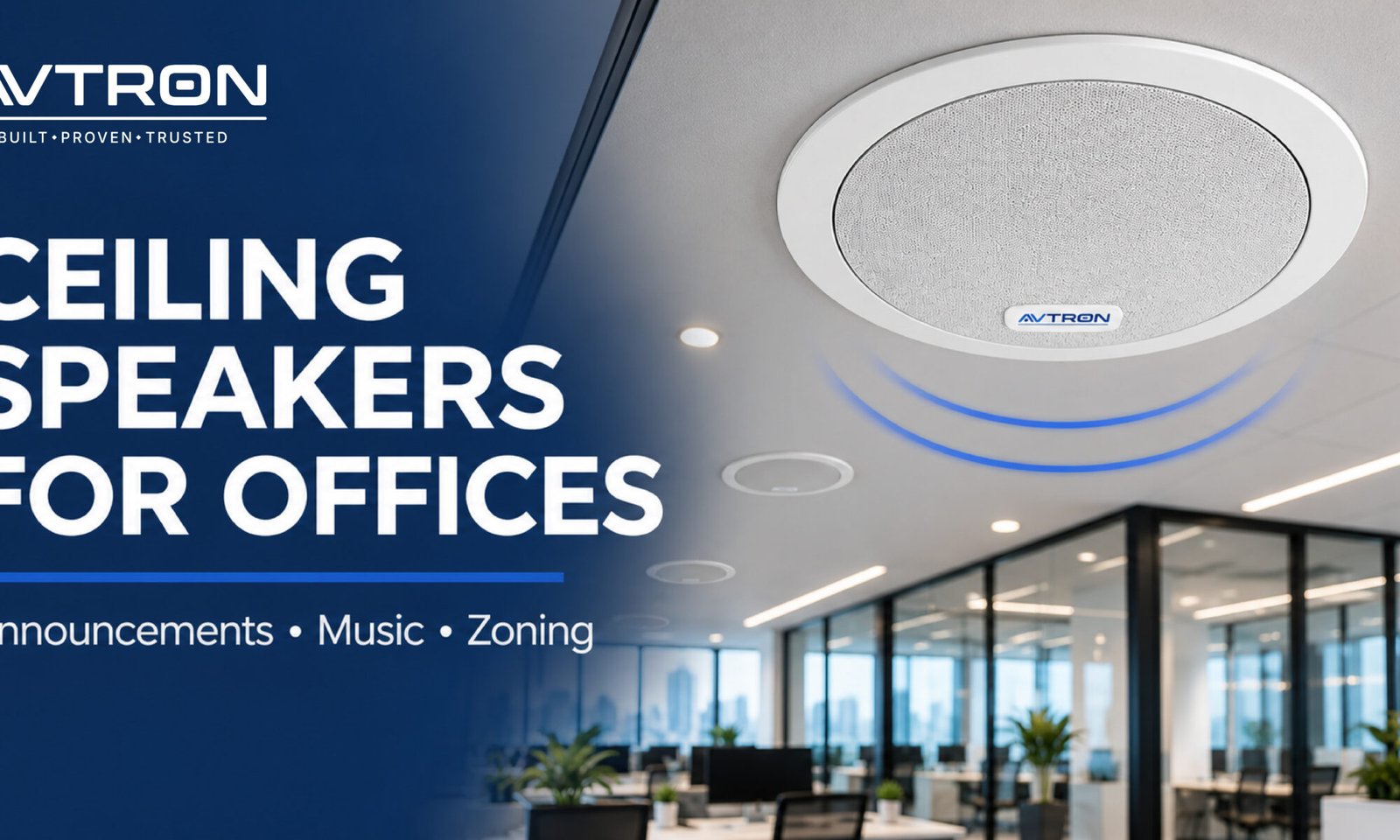
Why Office PA System Design Is Underestimated
In most office fit-out and renovation projects, the public address system receives less design attention than it deserves. Lighting, HVAC, and network cabling are planned with precision. The PA system is often treated as a secondary consideration, specified late in the process and installed with minimal acoustic planning.
The result is predictable. Announcements that do not reach the far end of the floor. Uneven background music that is too loud near speakers and inaudible in between. Zones that cannot be addressed independently. A system that technically works but does not work well enough to serve the communication needs of the organization.
A well-designed office PA system is not a complex or expensive undertaking. But it does require deliberate decisions at the right stage of the project. This guide covers those decisions, starting with why ceiling speakers for offices are the standard choice for office environments and ending with a practical framework for designing a system that performs across every zone of the building.

What Ceiling Speakers Are and Why Offices Prefer Them
A ceiling speaker is a loudspeaker unit designed to be flush-mounted or surface-mounted in a ceiling, projecting sound downward toward the listener plane below. The driver and housing are engineered to deliver audio across a defined coverage angle, typically 90 to 120 degrees, at controlled volume levels suited to enclosed, relatively quiet environments.
Offices prefer ceiling speakers for three practical reasons.
Aesthetic integration: Ceiling speakers are designed to sit flush within a suspended ceiling grid or to be surface-mounted with minimal visual profile. They do not interrupt the visual language of a professional office environment in the way that wall-mounted or pole-mounted speakers would.
Even sound distribution: Because ceiling speakers are distributed across the ceiling plane at regular intervals, they produce a relatively even sound field across the listening area below. Listeners at different positions across the office floor receive similar volume levels, without the hot spots and dead zones that result from fewer, more powerful speakers placed at the perimeter.
Low-volume intelligibility: Ceiling speakers are designed to deliver clear audio at lower volume levels, which is appropriate for office environments where background noise is minimal and occupant comfort is a priority. The same coverage outcome that would require a high-powered horn speaker in a factory can be achieved in an office at a fraction of the sound pressure level.
The Acoustic Environment of a Modern Office
Understanding the acoustic character of an office environment is the starting point for effective PA system design.
Low ambient noise: Most office environments operate at ambient noise levels between 40 dB and 60 dB. Air conditioning, keyboard and printer noise, and conversational murmur are the primary contributors. This relatively low noise floor means that ceiling speakers do not need to produce high sound pressure levels to achieve intelligible announcements or comfortable background music levels.
Acoustic variety across zones: A modern office is not acoustically uniform. Open-plan work areas, enclosed meeting rooms, reception lobbies, cafeterias, and corridors each have different acoustic characteristics. Open-plan areas with soft furnishings, carpet, and acoustic panels absorb sound. Hard-surfaced lobbies and corridors reflect it. These differences affect speaker placement and volume requirements zone by zone.
Ceiling height variation: Standard office ceiling heights range from 2.7 metres to 4 metres in most commercial buildings. Higher ceilings in lobbies, atriums, or double-height spaces require different speaker placement and potentially different speaker types to maintain intelligibility at floor level.
Mixed use requirements: Unlike a factory PA system that serves a single primary function, an office PA system is typically required to serve several simultaneously or in sequence. Background music during working hours, paging for visitor announcements, shift or floor alerts, and emergency communication are all expected from the same infrastructure.
Key Specifications to Evaluate Before You Specify
Sensitivity (dB/W/m): Sensitivity determines how much sound output the speaker produces from a given input power. ceiling speakers for offices, sensitivity ratings typically range from 85 dB/W/m to 96 dB/W/m. In a low-ambient-noise office environment, high sensitivity is less critical than in an industrial environment, but it still determines how many speakers are needed to achieve consistent coverage at the required volume level.
Power Handling (Watts): Office ceiling speakers are typically rated between 3W and 15W. For background music and paging applications, 6W is a common specification for a standard open-plan office zone. Meeting rooms and smaller enclosed spaces may be adequately served by a 3W unit.
Coverage Angle: A ceiling speaker with a 90-degree coverage angle mounted at 3 metres height produces a coverage circle of approximately 5 to 6 metres in diameter at the listener plane. Speakers are placed at intervals that produce overlapping coverage circles, ensuring consistent sound across the entire zone.
Frequency Response: For offices where background music is a requirement alongside speech, a ceiling speaker with a broader frequency response (80 Hz to 20,000 Hz) is preferable to one optimised only for speech frequencies. For installations where paging and announcements are the sole function, a narrower speech-optimised response is adequate and typically less expensive.
Impedance and System Compatibility: Ceiling speakers are most commonly configured as 100V line systems in commercial office installations. This allows multiple speakers to be connected in parallel across long cable runs without signal loss, and allows individual speaker volumes to be set via transformer taps. Confirm that the speakers specified are compatible with the amplifier system being used.
Aesthetics and Finish: In executive offices, boardrooms, and client-facing spaces, the physical appearance of ceiling speaker units is a legitimate specification consideration. Flush-mount round ceiling speakers with a white or RAL-colour grille are standard for these environments.
Zoning an Office PA System: The Design Decision That Drives Usability
Zoning is the single most important design decision in an office PA system, and it is the one most frequently underspecified.
A single-zone office PA system broadcasts every announcement to every speaker simultaneously. In a large office, this means a visitor paging announcement for the reception area also plays in every meeting room, every workstation cluster, and every private office in the building. The operational disruption this creates is significant and largely unnecessary.
A zoned system allows the facility manager or receptionist to address specific areas independently. The reception zone receives visitor announcements. The cafeteria receives general paging during lunch hours. The meeting room floor receives a prompt that a scheduled room is ready. An emergency message, when required, overrides all zones simultaneously.
Recommended zone structure for a typical office building
| Office Area | Recommended Zone Treatment |
| Reception and lobby | Independent zone |
| Open plan work floors | Per floor or per wing |
| Meeting rooms | Individual or grouped zone |
| Cafeteria and break areas | Independent zone |
| Corridors and stairwells | Grouped zone |
| Car park and external areas | Separate zone with appropriate speaker type |
| Server room and utility areas | Typically excluded |
For office buildings above a defined floor count or area, zone count also has implications for fire NOC compliance and EVAC/PAVA system integration. Avtron’s Voice Alarm Systems category covers integration-ready products for buildings where the PA system must also serve as the emergency voice communication layer.
Background Music, Paging and Emergency: Managing Multiple Functions from One System
An office PA system that serves multiple functions needs to be designed with a clear priority hierarchy.
Background music: runs as the lowest priority layer. It plays continuously in designated zones during defined hours, managed either through a scheduled audio source or a streaming input connected to the PA system.
Paging and announcements: take priority over background music automatically when initiated. The system should be configured so that a paging input from the reception desk, a floor administrator, or a central control point immediately interrupts background audio in the relevant zone.
Emergency override: sits at the highest priority level. When triggered, it silences all other audio across all zones simultaneously and broadcasts the emergency message or live announcement without requiring manual intervention at the zone level.
This three-layer priority hierarchy should be defined and configured during system commissioning, not assumed. A system where an emergency announcement has to compete with background music because the priority routing was not set correctly at installation is a system that has not been adequately commissioned.
IP Based Ceiling Speaker Systems for Modern Office Deployments
For offices that are already running on structured IP network cabling, IP based ceiling speaker systems offer a set of practical advantages over traditional analog 100V line systems.
An IP ceiling speaker connects to the local area network rather than to a dedicated audio cable run. It receives audio as a digital stream over the network and converts it to acoustic output at the speaker end. This means that wherever there is a network point in the ceiling or wall, there is a potential speaker location, without the need to run a separate audio cable back to an amplifier rack.
For multi-floor or multi-wing office buildings, IP PA systems also allow centralized management from a single interface. Zone configurations, volume levels, schedules, and input sources can all be managed and updated remotely. Fault monitoring is built into the system architecture, with alerts generated if a speaker or network segment reports an issue.
Avtron technology is a manufacturing organization with established presence across security, surveillance, and communication infrastructure in India. For offices evaluating IP ceiling speaker systems, Avtron’s technical team provides configuration support, zone planning guidance, and product documentation for projects of varied scale.
Planning Coverage: How Many Speakers, Where, and Why
A practical ceiling speaker coverage calculation for a standard office environment follows a straightforward process.
Step one: Determine ceiling height At a ceiling height of 3 metres, a ceiling speaker with a 90-degree coverage angle produces a coverage circle of approximately 5 to 6 metres in diameter at desk height.
Step two: Calculate coverage circles needed For an open-plan floor of 500 sq m with a standard 3-metre ceiling, approximately 16 to 20 ceiling speakers placed on a regular grid at 4 to 5 metre spacing will provide consistent coverage with appropriate overlap.
Step three: Account for zone boundaries Speakers near zone boundaries should be assigned to one zone only. In meeting rooms, a single ceiling speaker is typically sufficient for rooms up to 20 sq m. Larger conference rooms may require two speakers positioned to avoid the dead zone that occurs directly below a single centre-mounted unit.
Step four: Size the amplifier accordingly Total the wattage of all speakers in each zone. The amplifier serving that zone should be rated for at least 25 percent above the total connected speaker load to provide operational headroom.
What Indian Office Environments Must Account for Specifically
Power supply variation: Offices across many Indian cities experience voltage fluctuations and brief power interruptions. PA amplifiers should be specified with input voltage tolerance that accommodates the actual supply conditions of the facility. For buildings where communication continuity during power interruption is a requirement, UPS backup for the PA system should be part of the installation design.
Mixed occupancy buildings: Many commercial office buildings in India house multiple tenants across multiple floors. In these environments, the PA system may need to operate independently per tenancy while sharing building-wide emergency broadcast capability. This requires a system architecture that supports both independent zone management per tenant and centralized emergency override at the building level.
Compliance with NBC 2016 and fire NOC requirements: For commercial office buildings above defined height or floor area thresholds, public address and voice alarm requirements under NBC 2016 and state fire NOC conditions may apply. Where the ceiling speaker PA system is also required to serve as the emergency voice communication layer, integration with a certified EVAC/PAVA system is necessary. Confirm compliance requirements with a qualified fire safety consultant before finalizing the specification.
Multi-language announcements: In offices with multilingual staff populations, pre-recorded announcements in multiple languages are a practical requirement. A PA system with a digital message library that supports multiple language recordings per message can accommodate this without additional hardware.
Avtron’s Ceiling Speaker and PA Range for Office Deployments
Avtron manufactures a range of ceiling speakers, PA amplifiers, and IP PA systems designed for commercial office environments. Products are built for the communication requirements of modern offices, including background music, paging, zoned announcements, and emergency override capability.
The ceiling speaker range covers standard flush-mount units for open-plan areas, surface-mount options for retrofit installations where suspended ceiling access is limited, and IP ceiling speakers for network-based deployments. PA amplifiers in the Avtron range support both analog 100V line distribution and IP-based audio delivery, with multi-zone output capability for offices requiring independent zone control.

Planning a Ceiling Speaker System for Your Office?
Designing a ceiling speaker PA system that delivers consistent audio across every zone of an office requires decisions that go beyond selecting a speaker model and an amplifier. Coverage planning, zone architecture, priority hierarchy, amplifier sizing, and compliance requirements all determine whether the system performs as required throughout the building’s operational life.
If you are planning a new office PA system or reviewing an existing installation, Avtron’s technical team can provide product documentation, zone planning guidance, and configuration support specific to your building type and requirements.
Frequently Asked Questions
Q1. How many ceiling speakers are needed for a standard open-plan office floor? For a floor with a 3-metre ceiling, one ceiling speaker per 20 to 25 sq m is a practical planning estimate, subject to acoustic conditions and coverage angle.
Q2. Can the same ceiling speaker system handle both background music and emergency announcements? Yes, provided the system is configured with a correct priority hierarchy so emergency messages override background audio automatically.
Q3. What is the difference between a 100V line ceiling speaker system and an IP ceiling speaker system? A 100V line system distributes audio over dedicated cable. An IP system delivers audio as a digital stream over the existing data network, removing the need for separate audio cabling.
Q4. Is a ceiling speaker PA system in an office required to comply with fire safety regulations in India? For commercial buildings above defined height and area thresholds, NBC 2016 and state fire NOC conditions may require the PA system to meet voice alarm standards. Confirm requirements with a fire safety consultant.
Q5. Can background music and paging operate simultaneously on the same ceiling speaker system? Background music and paging use the same speaker infrastructure but are managed through an input priority configuration. Paging interrupts background music in the relevant zone when initiated.


