


The Problem with Audio in Industrial Environments
An announcement that cannot be understood serves no purpose. In a quiet office, delivering a clear spoken message over a PA system is a straightforward engineering task. In an industrial environment, it is a significantly more demanding one.
Factories, warehouses, manufacturing plants, logistics hubs, and outdoor industrial yards share a set of acoustic characteristics that make standard audio equipment inadequate. Continuous machinery noise, reverberant metal and concrete structures, large open spans, and exposure to weather, dust, and temperature extremes create conditions where most speaker types fail to perform reliably.
The horn speaker exists to address this problem. It is not a generic speaker adapted for industrial use. It is a speaker category engineered from the ground up for high-noise, large-area, and environmentally demanding deployments.
This guide explains how horn speakers work, why they are the appropriate choice for industrial PA systems, what specifications matter when selecting one, and what to account for when planning a deployment in an Indian industrial context.
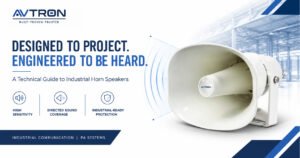
What a Horn Speaker Is and How It Works
A horn speaker is a loudspeaker in which the driver — the component that converts electrical signal to mechanical sound — is coupled to a horn-shaped waveguide. The horn shapes and directs the sound wave produced by the driver, controlling how it disperses into the environment.
This physical design produces two outcomes that are directly relevant to industrial use.
High efficiency: A horn speaker converts a greater proportion of the electrical power it receives into acoustic output compared to a direct-radiating speaker of equivalent wattage. This means a horn speaker can produce higher sound pressure levels from the same amplifier output. In an environment where you need to reach a listener 30, 50, or 80 metres away above significant background noise, this efficiency is not incidental. It is the fundamental reason the horn speaker works where other speaker types do not.
Directional dispersion: The horn controls the angle at which sound is projected. Rather than radiating sound in all directions simultaneously, a horn speaker projects it within a defined horizontal and vertical coverage angle. This allows sound energy to be directed toward the areas where listeners are present, rather than dispersing into empty space, ceilings, and adjacent structures where it contributes to reverberation without adding useful coverage.
These two properties together — efficiency and directionality — make the horn speaker the engineering-appropriate choice for industrial environments where volume, distance, and intelligibility must all be achieved simultaneously.
Why Horn Speakers Are the Standard Choice for Industrial PA
The choice of horn speakers for industrial PA systems is not a convention that persists without reason. It is the product of the specific acoustic and environmental demands that industrial facilities place on communication hardware.
Ambient noise levels: Industrial ambient noise typically ranges from 75 dB to over 95 dB depending on the type of operations. To achieve intelligible speech in these conditions, the PA system must produce a signal that is at minimum 10 to 15 dB above the ambient noise floor at the listener’s position. This is referred to as the signal-to-noise ratio requirement. Horn speakers, with their high sensitivity and directional projection, are built to meet this requirement at practical distances and with practical amplifier power.
Coverage distance: In large warehouses, factory floors, and outdoor yards, listeners may be 30 to 100 metres or more from the nearest speaker. A ceiling speaker rated at 6W in a domestic or commercial acoustic environment cannot project intelligible speech across these distances in the presence of industrial noise. A horn speaker operating at 15W to 30W, positioned and aimed correctly, can cover these distances with adequate intelligibility.
Durability requirements: Industrial environments expose equipment to conditions that standard speakers are not designed for. Temperature extremes, moisture, dust, vibration, and UV exposure all degrade standard speaker hardware over time. Horn speakers are designed with enclosures and materials that are rated for these conditions, typically with IP54 to IP67 ratings depending on the variant and application.
Key Specifications to Understand Before You Specify
Selecting a horn speaker without understanding the relevant specifications leads to either under-performance in the field or overspending on capability that the installation does not require. The following parameters are the ones that matter.
- Sensitivity (dB/W/m): Sensitivity measures how much sound pressure level a speaker produces from 1 watt of input power at a distance of 1 metre. A higher sensitivity rating means more output from the same amplifier power. Industrial horn speakers typically range from 100 dB/W/m to 115 dB/W/m. For high-noise environments, sensitivity is one of the most important specifications to evaluate.
- Power Handling (Watts): Power handling defines how much continuous electrical power the speaker can accept without damage. This must be matched to the amplifier output and the speaker load configuration. Industrial horn speakers typically range from 6W to 30W, with some high-output models reaching 50W and above.
- Sound Pressure Level (SPL): SPL is the actual acoustic output of the speaker at a defined distance, expressed in decibels. It is a direct function of sensitivity and input power. For industrial environments with ambient noise above 85 dB, a maximum SPL of at least 110 dB at 1 metre is a practical working minimum.
- Coverage Angle: Coverage angle defines the horizontal and vertical spread of the sound pattern. A narrow coverage angle projects sound further along a defined axis. A wider angle covers a broader area but with reduced projection distance. Matching coverage angle to the physical geometry of the space is a core part of horn speaker placement planning.
- Frequency Response: Speech intelligibility is primarily determined by the reproduction of frequencies in the 500 Hz to 4,000 Hz range. A horn speaker with a flat, accurate response across this range will produce more intelligible speech than one optimised for extended bass or very high frequencies.
- IP Rating: The Ingress Protection rating defines the speaker’s resistance to solid particulates and liquids. For indoor industrial environments, IP54 is a practical minimum. For outdoor yards, loading docks, and areas exposed to rain or washdown, IP65 or IP66 is appropriate. For submersion-risk environments, IP67 is the relevant rating.
- Operating Temperature: Confirm the rated operating temperature range against the actual conditions of the installation environment. Facilities in northern India that experience sub-zero winters and Indian summer temperatures exceeding 45 degrees Celsius require hardware with a correspondingly wide operating range.
| Specification | Minimum for Indoor Industrial | Minimum for Outdoor Industrial |
| Sensitivity | 100 dB/W/m | 105 dB/W/m |
| Power handling | 15W | 20W |
| IP rating | IP54 | IP65 |
| Operating temperature | 0°C to 50°C | Minus 10°C to 55°C |
| Coverage angle | 90 to 120 degrees horizontal | 60 to 90 degrees horizontal |
Types of Horn Speakers and Their Applications
Horn speakers are not a single product. The category includes several variants, each suited to a different deployment context.
Analog Horn Speakers: The standard horn speaker operating on a 100V line or low-impedance audio distribution system. Connects directly to a PA amplifier via audio cable. Suitable for facilities with existing analog PA infrastructure or new installations where IP networking is not available or required.
IP Horn Speakers: An IP horn speaker connects to the local area network rather than to an audio cable run. It receives audio as a digital stream over the network, converting it to acoustic output at the speaker end. This allows placement anywhere there is a network point, without the need to run dedicated audio cabling. Useful for large or multi-building facilities where running audio cable across long distances is impractical.
SIP Horn Speakers: A SIP horn speaker operates as an endpoint on the facility’s IP phone system, in the same way as a desk phone or softphone. This means announcements can be initiated from a phone extension, a softphone application, or a paging controller — using the existing telephone infrastructure. A plant manager can broadcast to a specific zone directly from their desk phone without a separate PA control interface.
Weatherproof and Flame-Resistant Variants: For facilities with specific compliance requirements — including chemical plants, oil and gas environments, or facilities subject to fire safety standards requiring fire-rated equipment — flame-resistant or weatherproof horn speaker variants are the appropriate specification.
| Horn Speaker Type | Connection Method | Best Suited For |
| Analog horn speaker | 100V line or low-impedance cable | Standard industrial PA installations |
| IP horn speaker | LAN network cable | Large multi-building or multi-zone facilities |
| SIP horn speaker | LAN network via SIP protocol | Facilities with existing IP phone systems |
| Weatherproof variant | Analog or IP | Outdoor yards, loading docks, exposed areas |
| Flame-resistant variant | Analog or IP | Chemical, oil and gas, and fire-regulated environments |
Placement and Coverage: Getting It Right on the First Install
Horn speaker placement determines whether a PA system performs as designed or requires expensive remediation after installation. The following principles apply across industrial environments.
Mount height and aim angle: Horn speakers in large indoor facilities are typically mounted at 4 to 8 metres above floor level, aimed downward at an angle that directs coverage toward the listener plane. Mounting too high reduces intelligibility at floor level. Mounting too low creates coverage gaps between speakers and may expose the unit to accidental damage.
Coverage overlap: Adjacent horn speakers should have a coverage overlap of 20 to 30 percent at the boundary of their coverage areas. This ensures that there are no dead zones between speakers where volume and intelligibility fall below the required threshold.
Avoid mounting in highly reverberant positions: Speakers mounted directly facing large flat metal surfaces — such as roller shutter doors, metal partition walls, or storage racking — create early reflections that reduce intelligibility. Where possible, aim speakers away from highly reflective surfaces or angle them to minimize direct reflection.
Outdoor yard coverage: For outdoor areas, horn speakers should be pole-mounted or building-mounted at heights of 5 to 10 metres, aimed across the coverage area. Account for wind direction and ambient noise from loading vehicles when determining the number of speakers and their placement.
IP and SIP Based Horn Speakers: The Network-Connected Option
For facilities that have invested in structured IP network cabling, IP and SIP based horn speakers offer a practical alternative to running dedicated audio cable infrastructure.
The operational advantage is straightforward. Wherever there is a network point, there is a potential speaker location. A new zone can be added by connecting a speaker to the nearest network switch port, without pulling new audio cable across the facility.
For multi-site industrial operations, IP PA systems also support centralized management. A single control interface can schedule, manage, and monitor speakers across multiple facilities from one location, with fault alerts delivered remotely if a speaker or amplifier reports an issue.
Avtron is a technology manufacturing organization with established presence across security, surveillance, and communication infrastructure in India. For facilities evaluating IP or SIP based horn speakers, Avtron’s technical team provides configuration support and zone planning guidance.
Common Mistakes in Horn Speaker Specification
Selecting on price without reviewing sensitivity ratings: Two horn speakers at the same price point may have sensitivity ratings that differ by 6 to 8 dB. In a high-noise environment, that difference determines whether the system performs adequately or requires additional speakers to compensate.
Underspecifying IP rating for the actual environment: An IP54-rated speaker installed at a loading dock exposed to rain will degrade faster than the same speaker in an indoor application. Match the IP rating to the actual environmental exposure, not the general category of the facility.
Not accounting for reverberation in enclosed metal structures: Large enclosed metal warehouses and factory buildings can have reverberation times of 2 to 5 seconds or more. Without accounting for reverberation in speaker placement and selection, a system that is technically powerful enough may still produce indistinct audio.
Installing too few zones: A single-zone factory PA system that broadcasts every announcement to every area is operationally limiting and creates unnecessary noise in zones where an announcement is not relevant. Zoning costs should be evaluated against operational efficiency gains, not treated as an unnecessary addition.
Ignoring amplifier headroom: Running amplifiers at or near rated capacity for extended periods accelerates thermal wear and increases the risk of failure during continuous operation. A 20 to 30 percent headroom margin is a standard design practice.
What Indian Industrial Facilities Must Account for Specifically
Monsoon and humidity exposure: Outdoor speakers in Indian industrial facilities face sustained humidity, rain, and in coastal locations, salt-laden air. IP65 or IP66 rated enclosures and corrosion-resistant hardware are the practical specification for any outdoor deployment in India.
Summer temperature peaks: In facilities across Rajasthan, Gujarat, Maharashtra, and other states with high summer temperatures, ambient temperatures in outdoor and non-air-conditioned indoor spaces can reach 48 to 50 degrees Celsius. Confirm operating temperature ratings before specifying hardware for these environments.
Dust in agricultural and processing environments: Grain processing, cement, textile, and chemical handling facilities operate with elevated dust and particulate levels. IP6X ratings, which provide complete dust ingress protection, are relevant in these environments.
Compliance with NBC 2016 and fire NOC conditions: For industrial facilities above defined floor area thresholds, voice alarm and PA system requirements under NBC 2016 and state fire NOC conditions may apply. Where the PA system is also required to serve as the emergency voice communication layer, integration with a certified EVAC/PAVA system is necessary.
Avtron’s Horn Speaker Range for Industrial Deployment
Avtron manufactures a range of horn speakers and industrial PA products designed for deployment in factories, warehouses, logistics facilities, outdoor industrial yards, and other demanding environments across India.
The horn speaker range includes analog horn speakers for standard 100V line PA systems, IP horn speakers for network-based deployments, and SIP horn speakers for facilities with existing IP phone infrastructure. Products are built and tested across the operating conditions that Indian industrial environments present, including wide temperature ranges, dust exposure, moisture, and continuous operational uptime requirements.
Specifying a Horn Speaker for Your Facility?
Horn speaker selection for an industrial environment involves more variables than a standard PA installation. Ambient noise levels, coverage distances, environmental ratings, zoning requirements, and amplifier sizing all determine whether the system performs in real operating conditions.
If you are evaluating horn speakers for a factory, warehouse, or industrial facility, Avtron’s technical team can provide product documentation, sensitivity and coverage data, and configuration guidance specific to your installation environment.
Frequently Asked Questions
Q1. What is the difference between a horn speaker and a standard ceiling speaker? Horn speakers project sound directionally over long distances in high-noise environments. Ceiling speakers disperse sound in a wide pattern suited to quiet, low-ceiling indoor spaces.
Q2. What wattage horn speaker do I need for a factory floor with high ambient noise? For ambient noise above 85 dB, a horn speaker with a minimum sensitivity of 105 dB/W/m and a power handling of 15W to 30W is a practical starting point, subject to coverage distance.
Q3. Can a SIP horn speaker replace a traditional PA system in a factory? A SIP horn speaker can serve as the speaker endpoint in a network-based PA system, using the existing IP phone infrastructure for announcement initiation and zone control.
Q4. What IP rating is required for a horn speaker in an outdoor industrial yard? IP65 is the minimum recommended rating for outdoor industrial yards. For environments with high-pressure washdown or heavy rain exposure, IP66 is more appropriate.
Q5. How many horn speakers are typically needed to cover a 10,000 sq m factory floor? Coverage depends on ceiling height, ambient noise, and speaker specification. As a general reference, a horn speaker with a 90-degree horizontal coverage angle mounted at 6 metres height may cover 400 to 600 sq m per unit in moderate noise conditions.