


The Infrastructure Problem Nobody Talks About
When a CCTV camera produces intermittent footage, the camera is replaced. When a PA speaker drops audio, the amplifier is checked. When an IP PA system loses connection to a zone, the network switch is restarted. In most cases, the investigation stops there.
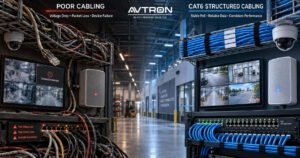
What is less often examined is the cable connecting these devices to the infrastructure that powers and networks them. Cabling is invisible once installed. It sits inside walls, above ceiling tiles, and under raised floors. It is not easy to inspect, not easy to replace, and not easy to diagnose as the source of a problem when a device at one end and a switch at the other both appear to be functioning.
Yet structured cabling is the layer on which every IP-based CCTV camera, every IP PA speaker, every access control reader, and every networked ELV device depends. When it is planned and installed correctly, it provides a reliable, long-service infrastructure that supports the security systems above it. When it is not, the consequences appear gradually and are expensive to resolve.
This guide addresses why Cat6 cable is the appropriate specification for modern ELV security deployments, how cabling quality directly affects CCTV and PA system performance, and what to account for when planning cabling infrastructure for a new or upgraded installation.

What Structured Cabling Is and What It Is Not
Structured cabling is a standardized approach to designing and installing the physical cabling infrastructure of a building or facility. It defines how cables are routed, terminated, labelled, and managed, and it specifies the performance standards that cables and connectors must meet.
The defining characteristic of structured cabling is that it is planned and installed as a system, not as a collection of individual point-to-point cable runs assembled over time. A structured cabling system has a defined architecture, a logical cable management scheme, and a documentation standard that allows any connection in the system to be traced, tested, and serviced.
What structured cabling is not is ad hoc cabling. Many facilities accumulate cabling infrastructure over years, with devices connected as they are added, cables run without a routing plan, and no consistent documentation of where cables go or what they connect. This approach produces an installation that functions at first and degrades over time, with faults that are difficult to locate and a physical infrastructure that cannot easily accommodate expansion or upgrade.
For ELV security systems, which include CCTV cameras, IP PA speakers, access control readers, fire alarm panels, and intercoms, a structured cabling approach is not optional for installations above a minimal scale. It is the foundation on which reliable system performance depends.
Why Cat6 Is the Relevant Standard for Modern ELV Systems
Category 6 (Cat6) cable is a twisted pair copper cable standard that supports data transmission at up to 10 Gbps over distances up to 55 metres, and 1 Gbps over the standard 100-metre horizontal cable run. It meets the performance requirements of IEEE 802.3 PoE and PoE+ standards and provides sufficient bandwidth headroom for high-resolution video streams, IP audio delivery, and simultaneous data and power delivery over a single cable.
For modern ELV security deployments, the relevant question is not whether Cat6 is adequate. It is whether a lower specification cable will create problems now or in the near future.
Cat5e, the previous generation standard, supports 1 Gbps at 100 metres and meets basic PoE requirements. In a CCTV deployment with a small number of standard-definition cameras, Cat5e may perform adequately at the time of installation. In a deployment with multiple high-resolution AI cameras, a Cat5e installation under full network load may begin to exhibit packet loss, latency, and PoE instability that is difficult to attribute to the cable without systematic testing.
The cost difference between Cat5e and Cat6 cable in a standard installation is modest. The cost of recabling a facility because the original specification was inadequate is not.
How Poor Cabling Causes CCTV System Failures
CCTV system failures that originate from cabling are among the most difficult to diagnose because they manifest as device or network problems rather than cable problems.
Intermittent video loss: A camera that drops its video feed periodically and reconnects without manual intervention is a common symptom of a marginal cable connection or a cable that is performing at the edge of its rated specification. The camera appears to function normally when tested in isolation. The problem recurs under load or under temperature conditions that affect cable performance.
Image quality degradation: High-resolution IP cameras transmit large data streams. A cable that is performing below its rated throughput, due to poor terminations, excessive length, or physical damage from bending or pinching during installation, may support the camera connection while dropping enough data to produce visible image degradation, including artefacts, pixelation, and motion blur.
POE instability: IP cameras are typically powered through the same Cat6 cable that carries their data, using Power over Ethernet. A cable with high resistance due to poor conductor quality, substandard terminations, or excessive length causes a voltage drop along the cable that reduces the power available at the camera end. This produces symptoms including cameras that restart unexpectedly, cameras that fail to initialize in cold conditions, and cameras that operate normally on the bench but intermittently in the installed position.
NVR disconnections: A network video recorder that periodically loses connection to one or more cameras, requiring a network restart or camera reboot to restore, is often attributed to NVR software or switch configuration. In many cases, the root cause is a cable that is marginally within specification under normal conditions but outside it under peak load or adverse temperature conditions.
How Poor Cabling Causes PA System Failures
IP PA and SIP-based PA systems are network-connected devices that face the same cabling dependencies as CCTV cameras, with additional sensitivity to latency and jitter that does not apply to video in the same way.
Audio dropout and interruption: An IP PA speaker or SIP horn speaker that experiences periodic audio dropout during an announcement is almost always experiencing packet loss on its network connection. Audio streams are sensitive to packet loss in a way that web browsing and file transfers are not. A cable that drops a small proportion of packets may not impair general network use noticeably while producing audible dropout in an IP audio stream.
Announcement delay: Network latency caused by a marginal cable connection or a poorly terminated patch panel introduces delay into the announcement delivery chain. In a zoned PA system where the same announcement is being delivered to multiple speakers simultaneously, inconsistent latency across cable runs of different quality causes announcements to arrive at different speakers at slightly different times, producing an echo or phasing effect across the coverage area.
Speaker offline status: An IP PA speaker or SIP horn speaker that appears offline on the management interface but is physically present and powered is frequently the result of a POE issue on the cable serving that speaker. The speaker does not receive adequate power to complete its initialization sequence and therefore does not register on the network.
Cat5e vs Cat6 vs Cat6A: What the Difference Means in Practice
| Specification | Cat5e | Cat6 | Cat6A |
| Maximum data rate | 1 Gbps | 10 Gbps (55m) / 1 Gbps (100m) | 10 Gbps (100m) |
| Bandwidth | 100 MHz | 250 MHz | 500 MHz |
| PoE support | 802.3af (15.4W) | 802.3at PoE+ (30W) | 802.3bt PoE++ (60W to 90W) |
| Crosstalk performance | Adequate for standard use | Improved alien crosstalk reduction | Full alien crosstalk shielding |
| Recommended for | Legacy upgrades and low-density standard-def CCTV | Standard ELV security deployments | High-density AI camera and PoE++ deployments |
| Cable diameter | Thin, easy to route | Standard | Larger, requires more conduit space |
For most ELV security deployments including AI cameras, IP PA systems, access control, and intercoms, Cat6 is the appropriate standard. Cat6A is relevant for high-density deployments where multiple high-power PoE devices share cable bundles and alien crosstalk between adjacent cables becomes a practical concern.
PoE and Why Cable Quality Determines Whether It Works
Power over Ethernet is the delivery of DC electrical power along the same Cat6 cable that carries network data. It allows a CCTV camera, IP PA speaker, access control reader, or VoIP phone to be powered from the network switch rather than from a separate power supply at the device location.
PoE depends on the cable’s resistance characteristics. Every meter of cable introduces a small amount of resistance. Over a 100-metre cable run, this resistance results in a voltage drop between the switch and the device. The PoE standard accounts for this drop within defined limits — but only if the cable meets its rated specification.
Cable that uses copper-clad aluminum (CCA) conductors rather than solid copper conductors has significantly higher resistance than the standard specifies. CCA cable is less expensive than solid copper and is available from a range of suppliers. It may pass a basic continuity test but fails to meet the resistance specification that POE depends on. In a CCTV or PA installation using CCA cable on longer runs, POE instability, device restarts, and inconsistent performance are predictable outcomes.
Specifying solid copper Cat6 cable from a supplier with verifiable conductor material is not a preference. It is a requirement for a POE-dependent ELV installation to perform reliably over its service life.
Planning a Structured Cabling System for ELV Security Deployments
Define the device inventory first: Before routing a single cable, establish the complete inventory of ELV devices to be installed. Every camera, every PA speaker, every access control reader, and every intercom requires a dedicated cable run. The device inventory determines the number of cable runs, the location of distribution points, and the size of the patch panels and switches required.
Design cable routing before construction is complete: Cable routing should be designed during the construction or fit-out planning stage, not after walls are closed and ceilings are installed. Retrofitting cable routes through a completed building is expensive and often results in compromises in cable quality due to tight bends, improper support, and excessive pull tension during installation.
Use dedicated conduit for ELV cabling: ELV security cables should be routed in dedicated conduits separate from power cables. Running Cat6 data cables parallel to 230V power cables for extended distances introduces electromagnetic interference that degrades signal quality and can affect POE performance.
Label and document every cable run: Every cable run should be labelled at both ends with a consistent identification scheme, and the routing, length, and termination point of every cable should be documented. This documentation allows faults to be located systematically and supports future expansion without requiring physical cable tracing.
Test every cable run after installation: A cable that passes a visual inspection may still fail to meet Cat6 performance standards if it was damaged during installation through excessive pulling tension, tight bend radii, or compression damage. Every cable run should be tested with a cable certifier against the Cat6 standard before the ELV devices are connected.
Avtron is a technology manufacturing organization with established presence across security, surveillance, and communication infrastructure in India. For structured cabling projects supporting Avtron ELV security system deployments, Avtron’s technical team and ADIT’s installation capability provide end-to-end project support from cabling design through to device commissioning.
Common Cabling Mistakes That Create Long-Term Problems
Using substandard cable to reduce cost: The cable itself is a small proportion of the total cost of an ELV security installation when labour, devices, and commissioning are accounted for. Using substandard cable to reduce material cost while leaving labour and device costs unchanged is a poor trade-off that creates long-term reliability problems for a marginal initial saving.
Exceeding maximum cable run length: The 100-metre maximum cable run for Cat6 includes the patch cords at both ends. A cable run of 95 metres plus two 3-metre patch cords exceeds the standard. In a CCTV installation, this may not cause an immediate visible problem but creates a marginal connection that degrades under temperature variation and load.
Over-bending cable during installation: Cat6 cable has a minimum bend radius that must not be exceeded during installation. Cables pulled sharply around corners, through tight conduit bends, or secured with over-tightened cable ties may pass an initial test but develop increased crosstalk and signal loss over time as the twisted pair geometry is distorted.
Leaving cable runs unterminated or improperly terminated: A cable that is not terminated correctly at the patch panel or wall outlet will not meet Cat6 performance specifications regardless of the cable quality. Termination technique, pair untwisting length, and connector type all affect the final performance of the cable run.
Not accounting for future expansion: An installation that uses exactly the number of cable runs required for the current device count provides no capacity for future expansion. Installing spare cable runs to potential device locations during the initial installation, while walls and ceilings are accessible, is significantly less expensive than adding them later.
What Indian Installations Must Account for Specifically
Temperature variation in cable performance: Cable performance degrades at elevated temperatures. In non-climate-controlled facilities across India where ambient temperatures can reach 45 to 50 degrees Celsius, cable resistance increases and POE efficiency decreases relative to performance at standard test conditions. This makes the margin between a marginal cable run and a failing one narrower in Indian summer conditions than laboratory specifications suggest.
Humidity and moisture ingress: In coastal locations and high-humidity environments, moisture ingress into improperly sealed cable terminations and wall outlets causes corrosion over time. This manifests as increasing contact resistance at termination points, producing intermittent connectivity that worsens over years.
Rodent damage in industrial and semi-urban locations: Warehouses, industrial facilities, and buildings in semi-urban locations are subject to rodent damage to cabling routed without adequate physical protection. Cable routes in these environments should use steel conduit or armoured cable trunking rather than plastic conduit or open cable trays.
Counterfeit and substandard cable in the supply chain: The Indian cable market includes a proportion of cable that does not meet the Cat6 standard it is labelled as, including CCA conductor cable sold as pure copper Cat6. Specifying cable from verified suppliers with test documentation, and testing every cable run after installation, is the practical safeguard against this risk.
Avtron’s ELV Systems and the Cabling Infrastructure They Depend On
Avtron manufactures AI cameras, PTZ cameras, NVR systems, video management software, IP PA systems, SIP horn speakers, PA amplifiers, and EVAC/PAVA systems for deployment across commercial, institutional, and industrial premises in India. Every IP-based device in Avtron’s product range depends on a correctly specified and installed structured cabling infrastructure to perform as designed.
A Cat6 installation that meets the standard for conductor material, cable performance, termination quality, run length, and bend radius provides the foundation on which Avtron’s ELV security systems deliver reliable performance. A cabling installation that does not meet that standard creates conditions where device performance will be inconsistent, faults will be difficult to diagnose, and the investment in security hardware will not produce the outcome it was designed for.
Planning a Structured Cabling Infrastructure for Your ELV Security Project?
The cabling infrastructure of an ELV security installation is not a variable that can be addressed after the security systems are specified and the devices are selected. It is a design decision that must be made at the planning stage, because the cable specification, routing architecture, and installation quality determine whether the CCTV and PA systems above it perform reliably throughout their operational life.
If you are planning a new ELV security installation or reviewing the cabling infrastructure of an existing one, Avtron’s technical team can provide guidance on cabling requirements specific to the ELV systems being deployed.
Frequently Asked Questions
Q1. Is Cat6 cabling necessary for CCTV cameras or will Cat5e work? Cat5e is adequate for low-density standard-definition CCTV at short cable runs. For AI cameras, high-resolution IP cameras, and PoE+ powered devices, Cat6 is the appropriate specification for reliable long-term performance.
Q2. What is the maximum cable run length for Cat6 in a CCTV installation? The maximum horizontal cable run is 100 metres including patch cords at both ends. Runs approaching this limit should be tested after installation to confirm they meet Cat6 performance standards.
Q3. Why does cable quality affect PoE performance for cameras and PA speakers? PoE delivers power over the cable’s copper conductors. Substandard cable, particularly CCA conductor cable, has higher resistance than specified, causing voltage drop that reduces the power available at the device and produces instability.
Q4. How can I tell if my CCTV or PA failures are caused by cabling rather than the devices? Intermittent connectivity that resolves without device replacement, symptoms that worsen in summer heat, and problems that appear on longer cable runs first are indicators of cabling rather than device failure. Cable certification testing confirms whether runs meet the Cat6 standard.
Q5. Should ELV security cabling be run separately from power cables? Yes. ELV Cat6 cabling should be routed in separate conduits from 230V power cables to prevent electromagnetic interference that degrades signal quality and can affect PoE performance.